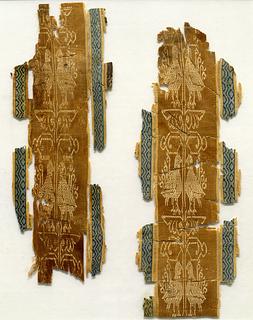
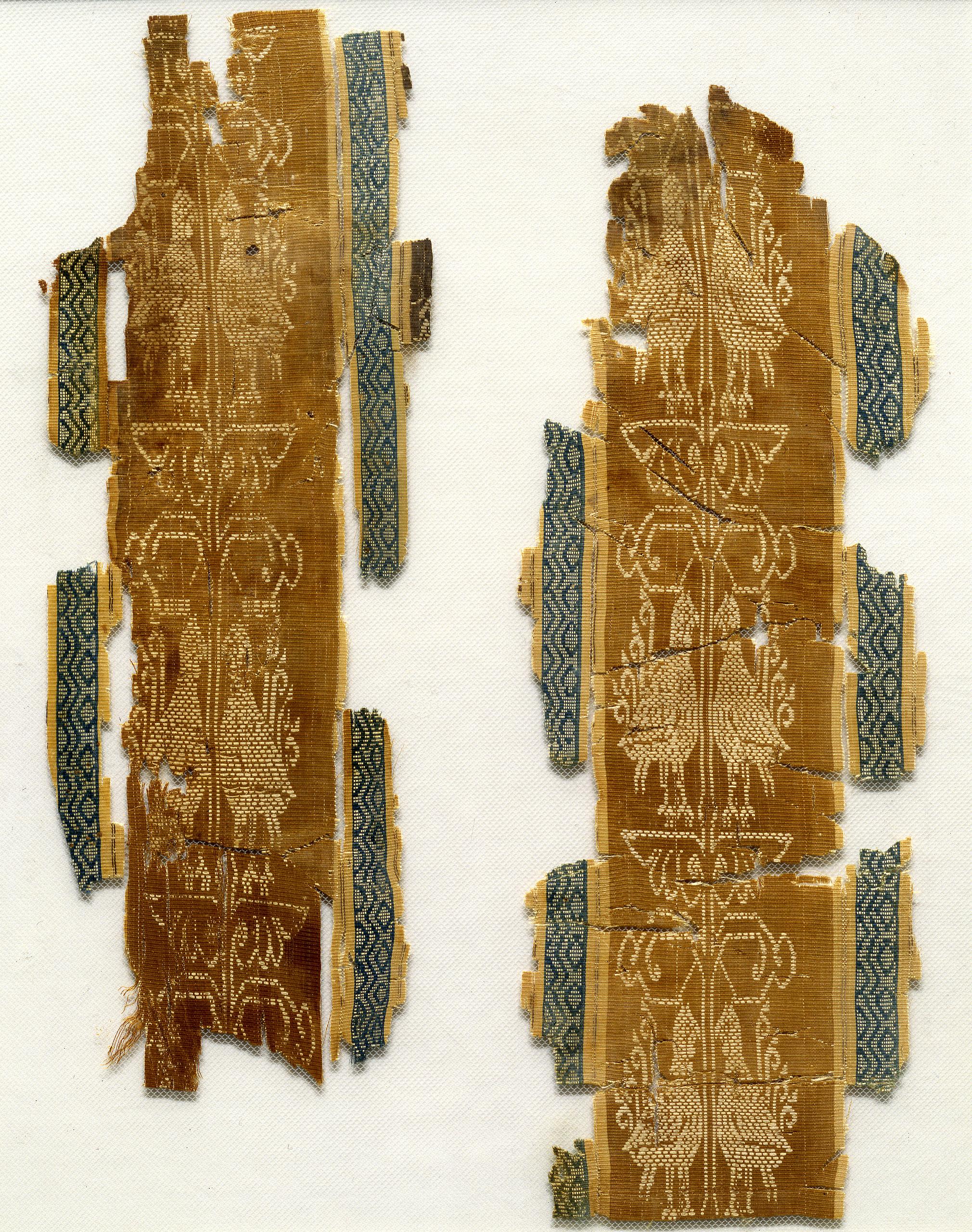
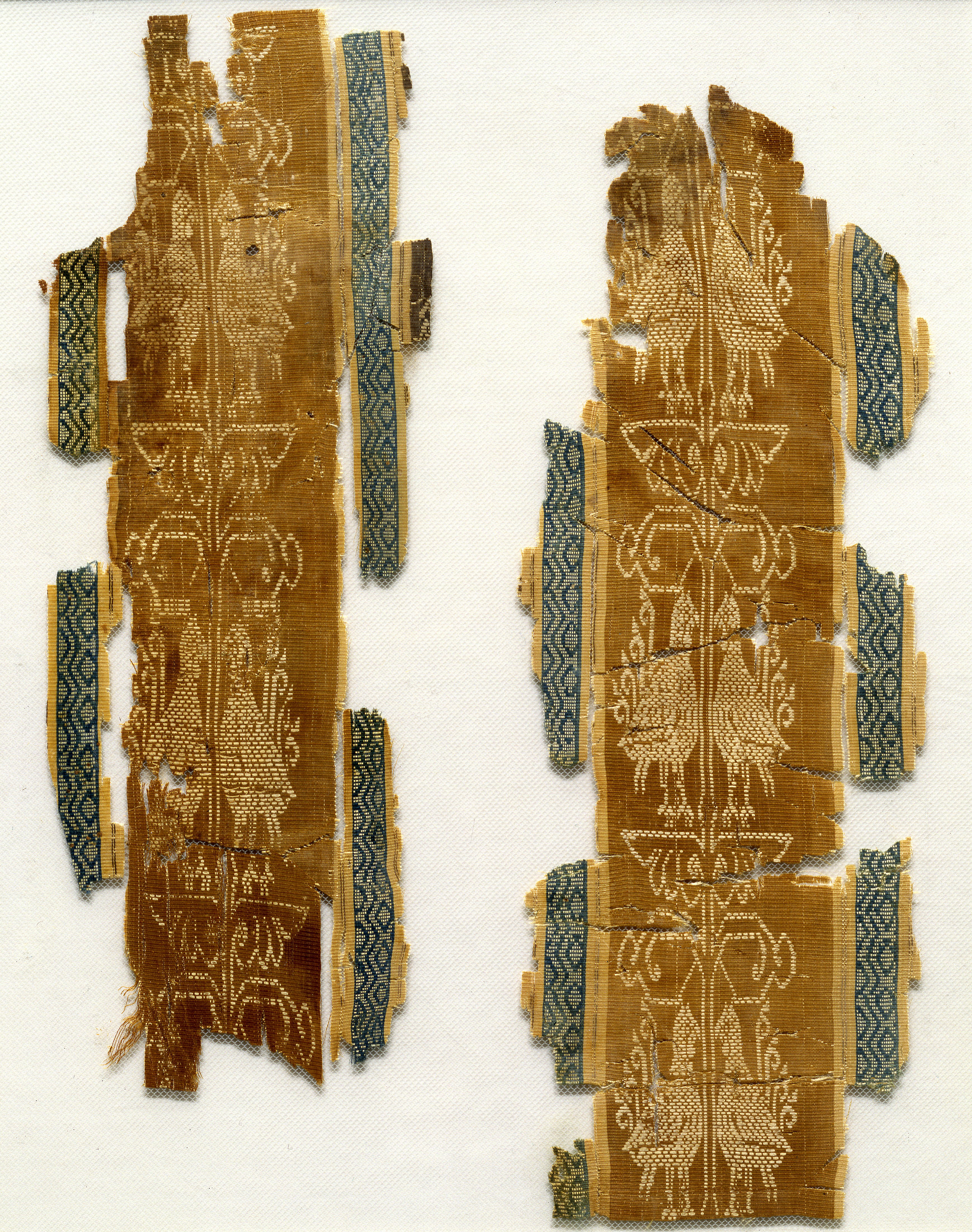
Silk, warp-faced tabby with pattern weft
Middle East; 11th-12th century
Size after mounting: H: 32.5; W: 23.5 cm
Inventory number 24/1992
The provenance of this textile and another silk (25/1992) is uncertain. Motifs with confronted cocks, peacocks, pheasants, or eagles on double palmettes are, however, frequently found on a number of early Islamic textiles that are usually linked with Iran or Central Asia and can be traced back to the Sasanian tradition. The birds – and at times also four-legged animals – in this group from the 7th-8th century, in contrast, are often enclosed in scalloped medallions (see e.g. 9/1996 and 4/2005).
The ground weave of the textiles is tabby, while the pattern is formed by tram silk that runs as an extra weft from selvage to selvage; a forerunner of the more complicated lampas technique.
The ground weave of the textiles is tabby, while the pattern is formed by tram silk that runs as an extra weft from selvage to selvage; a forerunner of the more complicated lampas technique.
Published in
Published in
Kjeld von Folsach and Anne-Marie Keblow Bernsted: Woven Treasures: Textiles from the World of Islam, The David Collection, Copenhagen 1993, cat. 9;
Kjeld von Folsach: Art from the World of Islam in The David Collection, Copenhagen 2001, cat. 632;
Corinne Mühlemann: Complex weaves: technique, text, and cultural history of striped silks, Affalterbach 2023, fig. 13, p. 45;
Corinne Mühlemann: Complex weaves: technique, text, and cultural history of striped silks, Affalterbach 2023, fig. 13, p. 45;