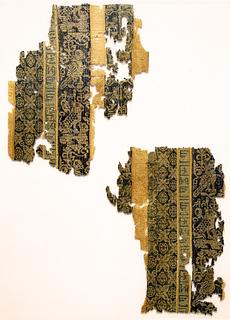
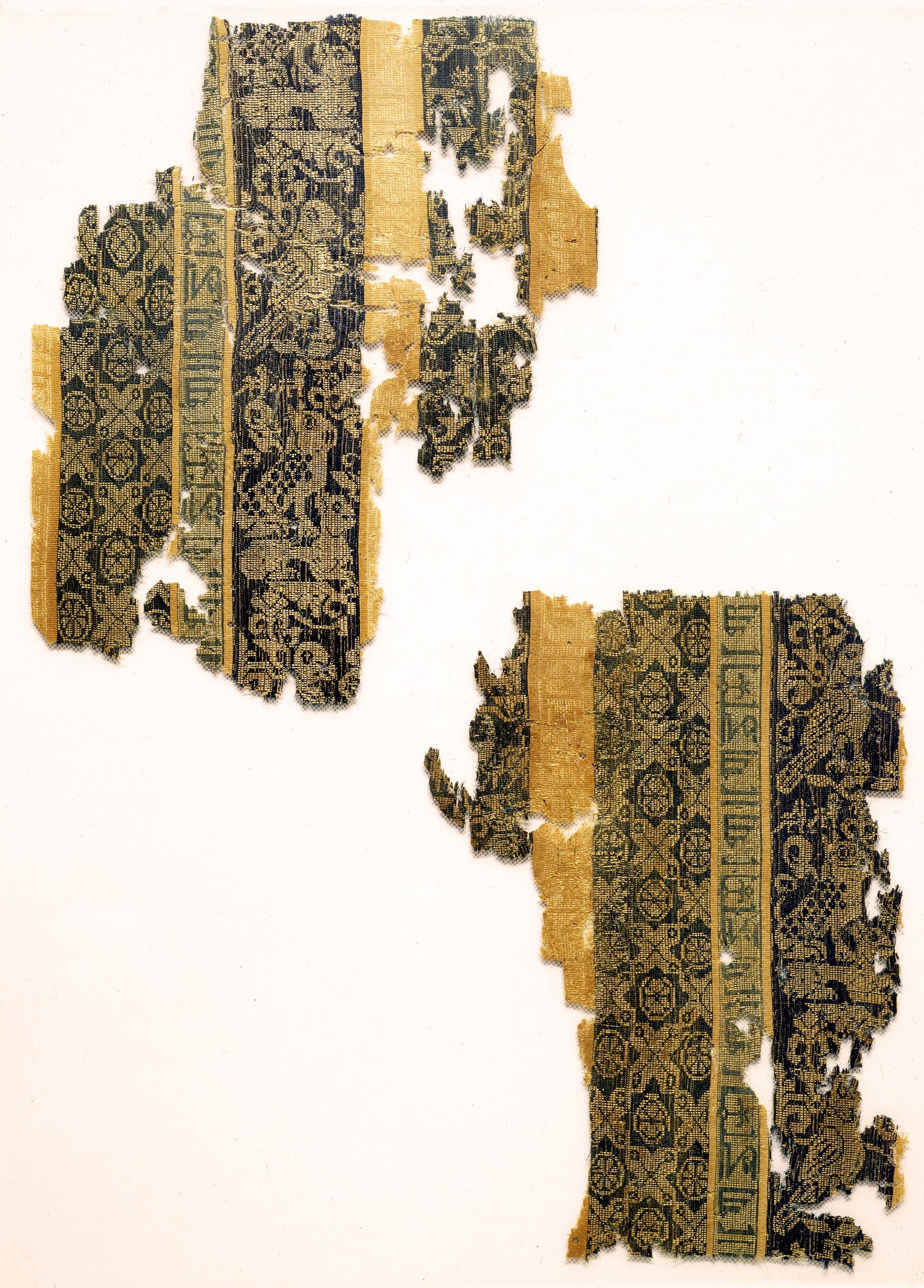
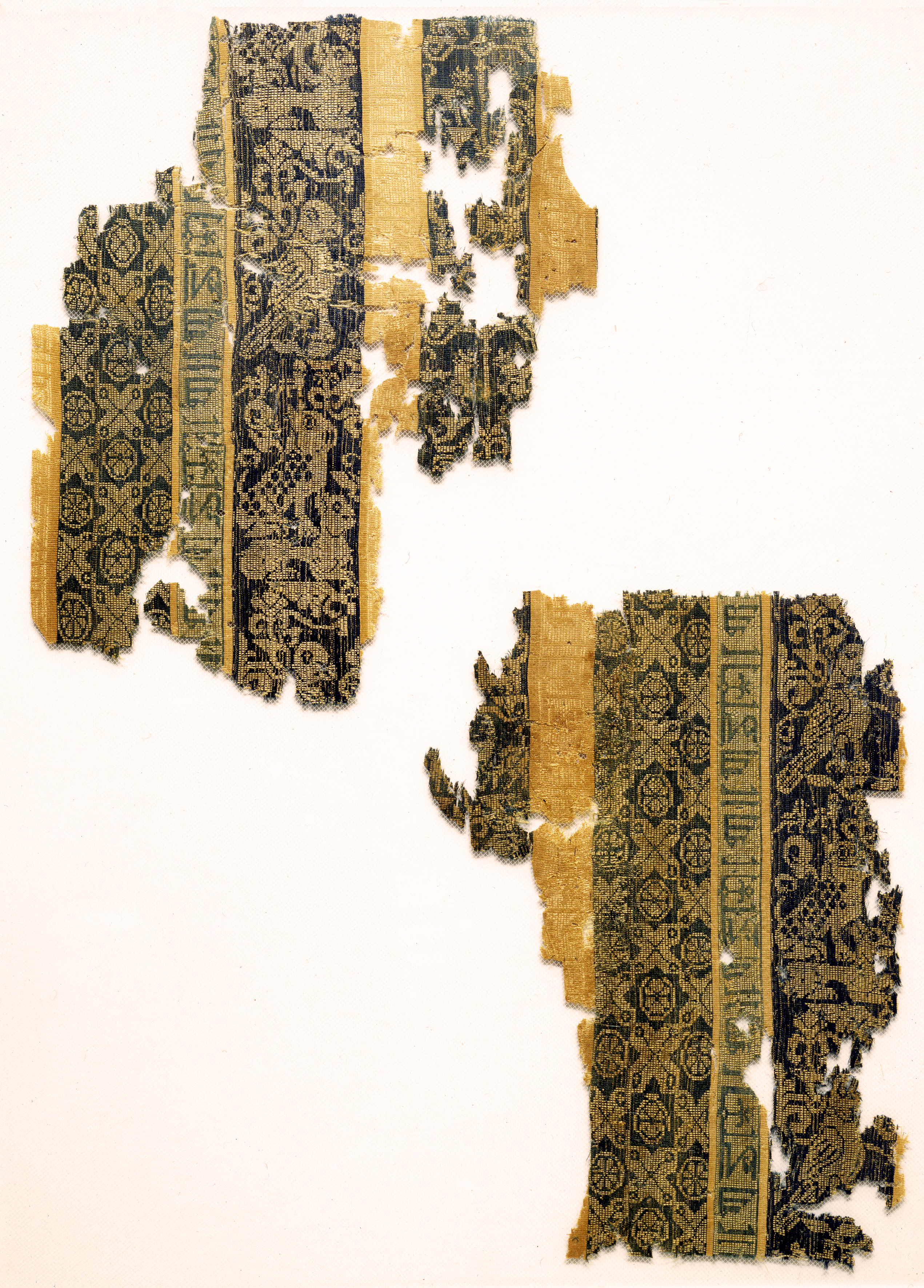
Tabby-woven textile, silk, decorated with pattern wefts
Middle East; 11th-12th century
H: 46; W: 32 cm
Inventory number 25/1992
The provenance of this textile is uncertain, but despite the Arabic inscription in Kufi – al-mulk l-illah (“royal power belongs to God”) – the type has most often been ascribed to Iran.
Motifs with eagles, falcons, lions, and other predators – hunting, confronted, or alone – are frequently associated with a princely iconography, or at least with social strata that modeled themselves on the ruling class. The becomingly modest inscription on this textile emphasizes a princely context.
A pattern weft is an extra weft that runs from selvage to selvage and forms the pattern.
Motifs with eagles, falcons, lions, and other predators – hunting, confronted, or alone – are frequently associated with a princely iconography, or at least with social strata that modeled themselves on the ruling class. The becomingly modest inscription on this textile emphasizes a princely context.
A pattern weft is an extra weft that runs from selvage to selvage and forms the pattern.
Published in
Published in
Sotheby’s, New York, 25/6-1992, lot 183;
Kjeld von Folsach and Anne-Marie Keblow Bernsted: Woven Treasures: Textiles from the World of Islam, The David Collection, Copenhagen 1993, cat.no. 10;
Kjeld von Folsach and Anne-Marie Keblow Bernsted: Woven Treasures: Textiles from the World of Islam, The David Collection, Copenhagen 1993, cat.no. 10;
Kjeld von Folsach, Torben Lundbæk and Peder Mortensen (eds.): Sultan, Shah and Great Mughal: the history and culture of the Islamic world, The National Museum, Copenhagen 1996, cat.no. 244;
Kjeld von Folsach: Art from the World of Islam in The David Collection, Copenhagen 2001, cat.no. 633;
Corinne Mühlemann: Complex weaves: technique, text, and cultural history of striped silks, Affalterbach 2023, fig. 12, p. 44;