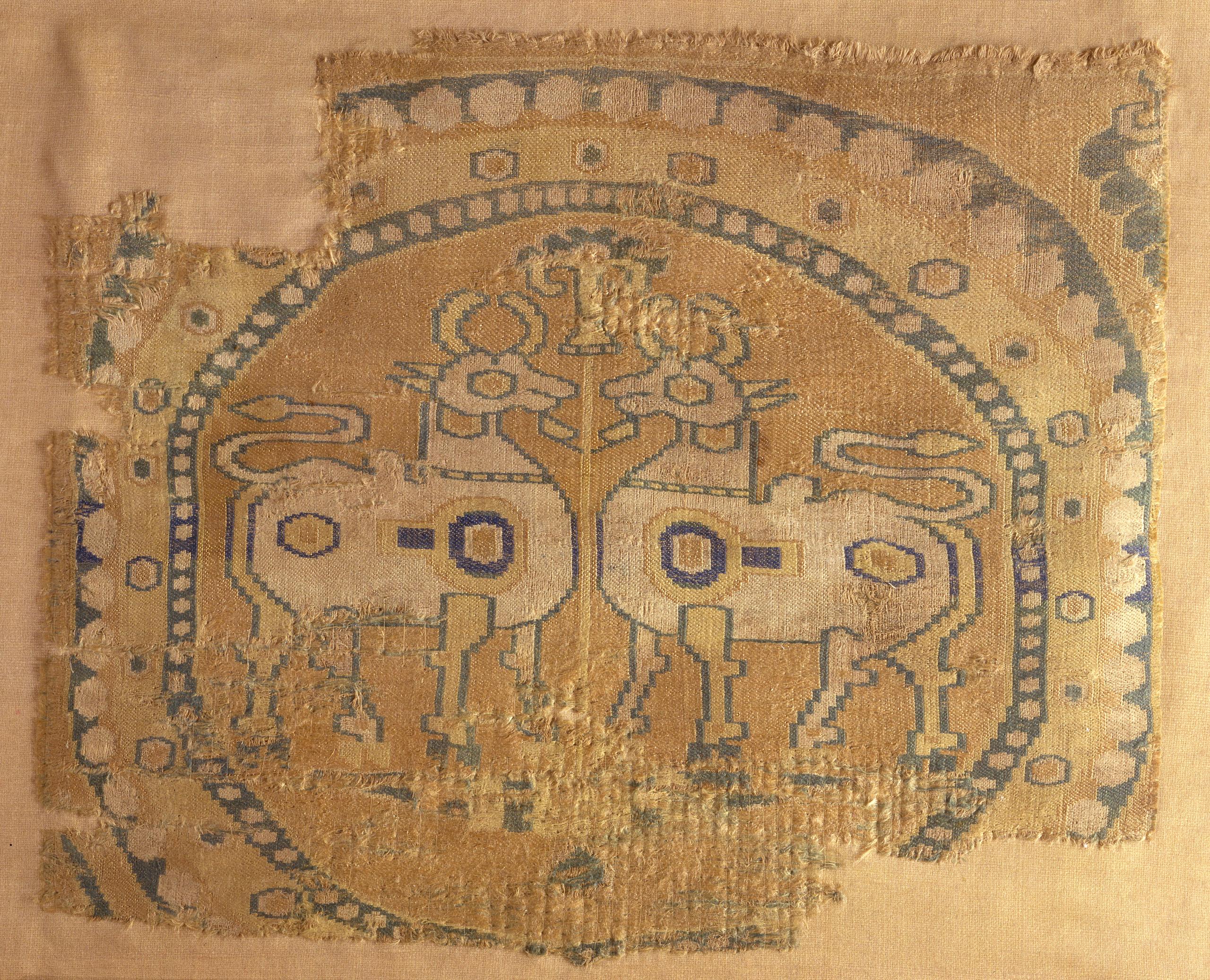
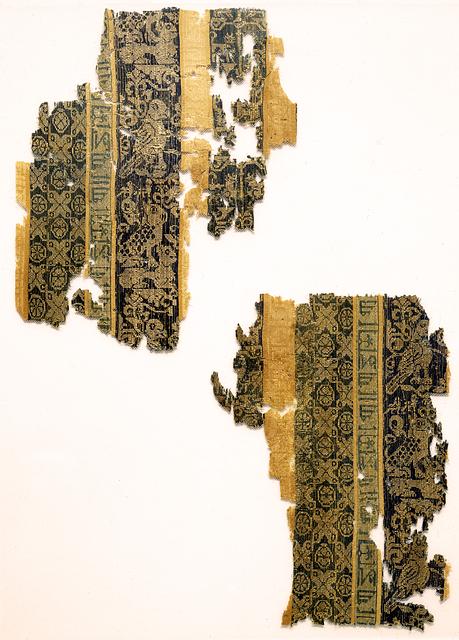
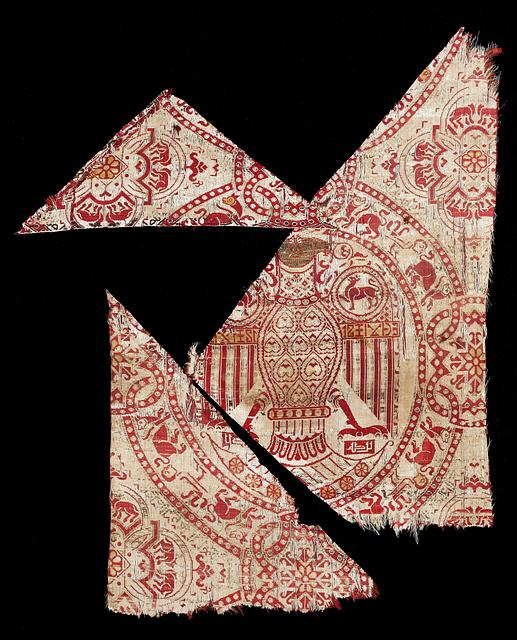
Fragment of a samitum-woven textile, silk
Eastern Iran or Central Asia; 8th-9th century
H: 32.5; W: 38.5 cm
Inventory number 10/1996
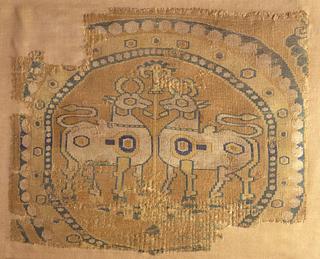
A textile like this one, with two confronted bulls in a beaded medallion, is clearly indebted to earlier Sasanian and Sogdian design traditions (see 4/2005). The bulls stood on a winged palmette, now almost worn away, with a stylized plant between them. The roundel over the animals’ forelegs – which looks rather like a Royal Air Force emblem – is a non-naturalistic element that was to prove unusually tenacious in later Islamic animal depictions, and was at times given a more almond-like shape.
The group to which this samitum-woven textile belongs has been ascribed on the basis of an inscription on a similar textile to the Central Asian city of Zandane, near Bukhara. The city was incorporated into the Umayyad caliphate in the beginning of the 8th century.
The group to which this samitum-woven textile belongs has been ascribed on the basis of an inscription on a similar textile to the Central Asian city of Zandane, near Bukhara. The city was incorporated into the Umayyad caliphate in the beginning of the 8th century.
Published in
Published in
Kjeld von Folsach: Art from the World of Islam in The David Collection, Copenhagen 2001, cat.no. 631;
Ellen Bangsbo: “A shared textile heritage: The origin and use of textile patterns in Himalaya and Tibet”, Archaeological textiles review, 65, 2023, fig. 3, p. 101;
Ellen Bangsbo: “A shared textile heritage: The origin and use of textile patterns in Himalaya and Tibet”, Archaeological textiles review, 65, 2023, fig. 3, p. 101;
.jpg)
.jpg)
.jpg?disposition=attachment)