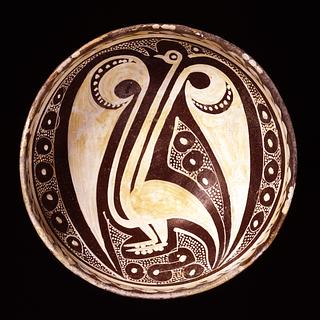
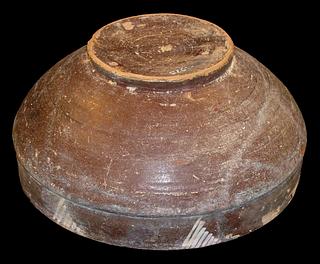
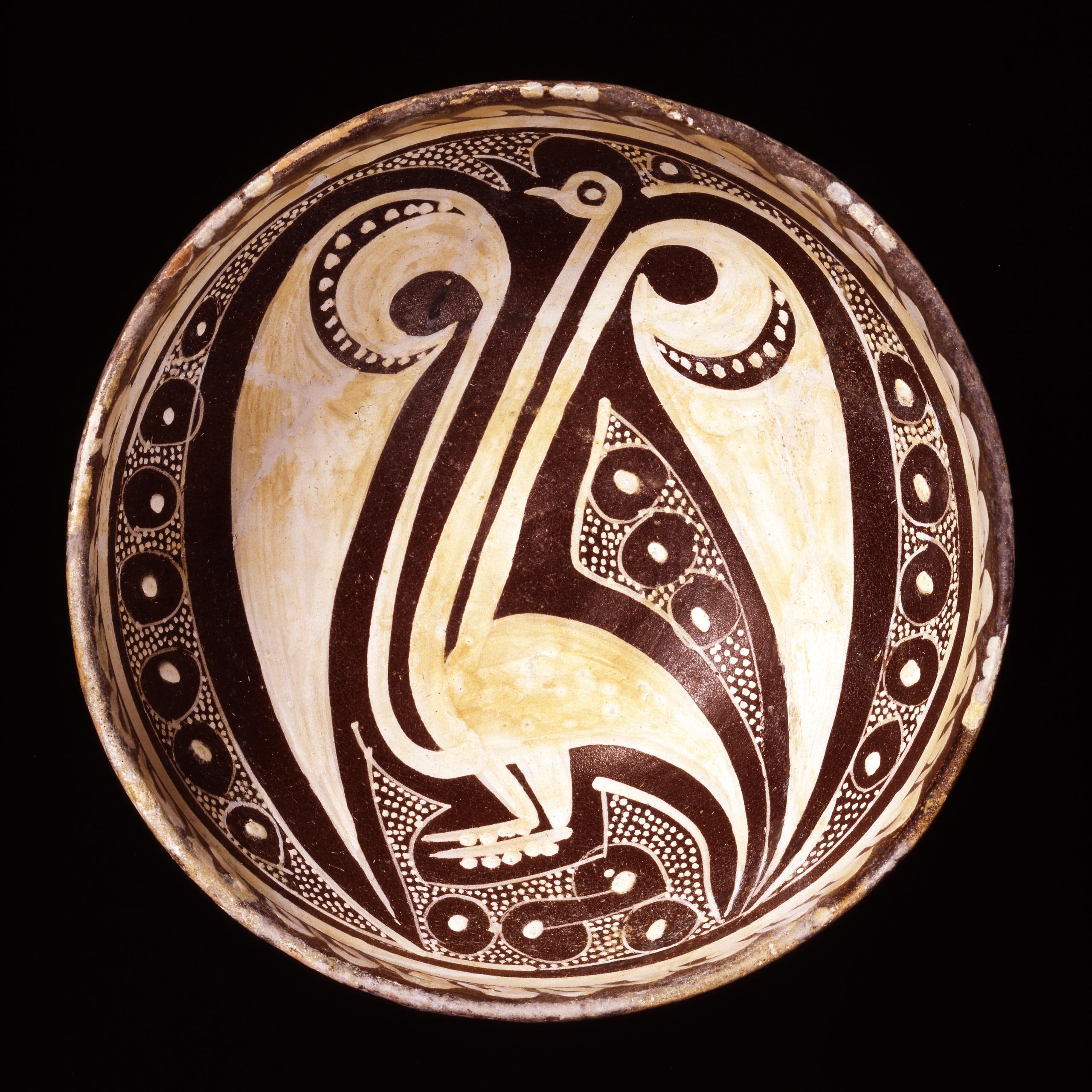
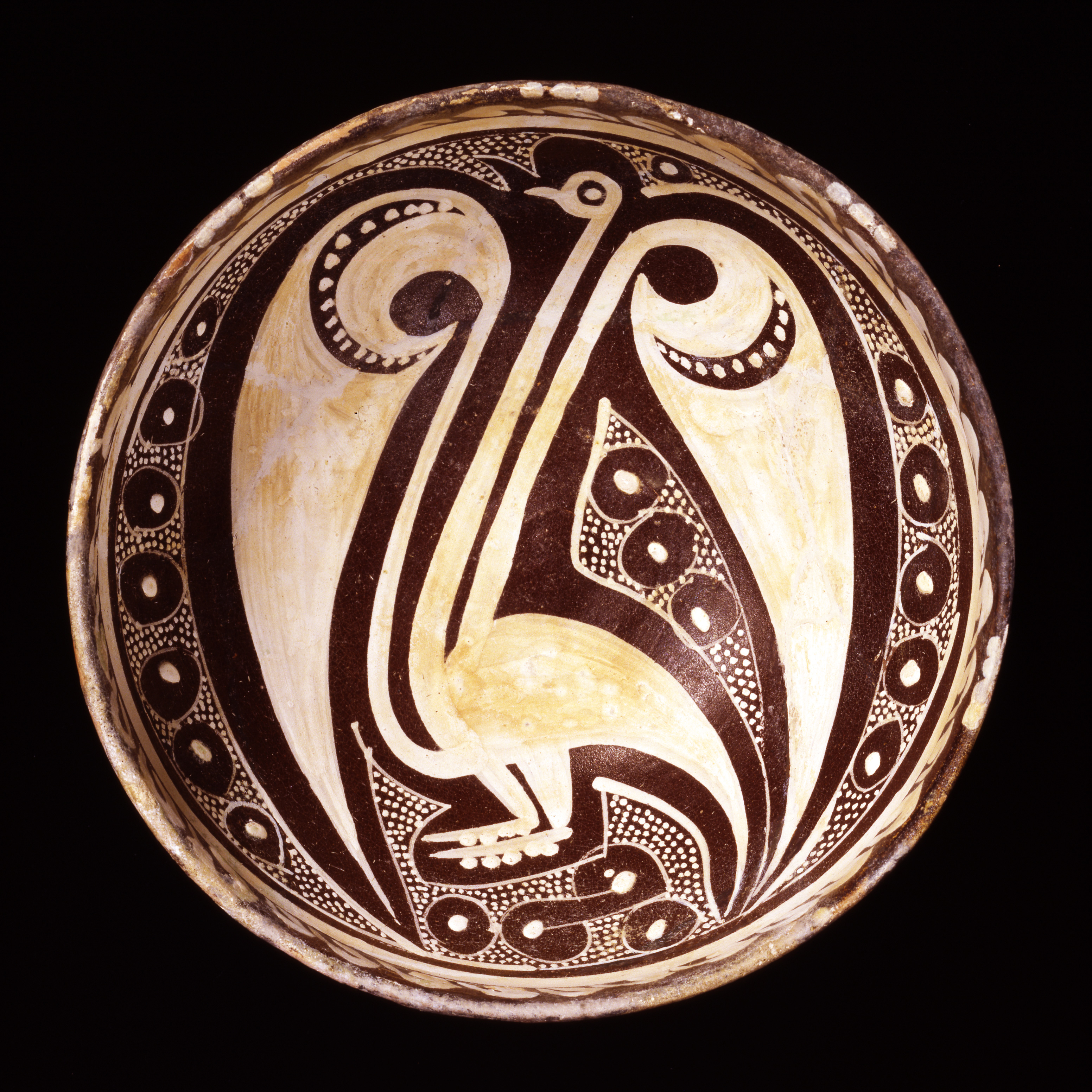
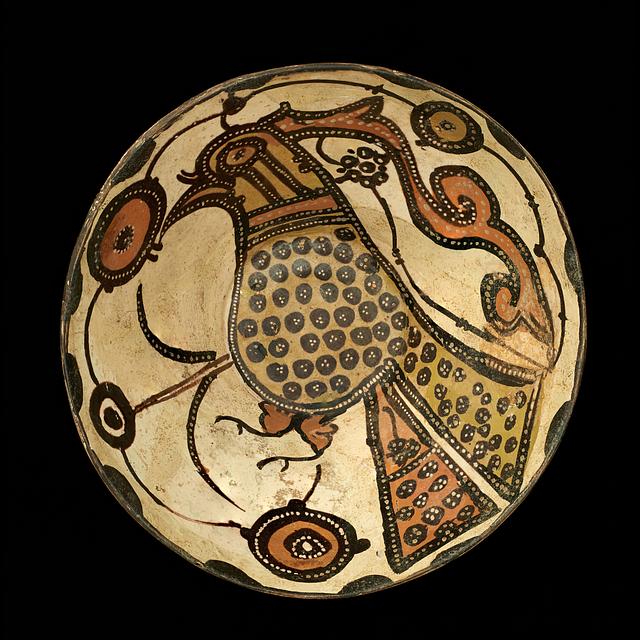
Earthenware bowl, covered with a brown slip and painted in a white slip under a transparent glaze that is now decomposed
Eastern Iran, Nishapur or Samarkand; 10th century
H: 8.5; Diam: 17.2 cm
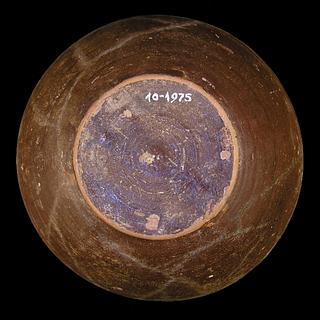
Inventory number 10/1975
The Samanids ruled large parts of Iran and Central Asia as independent governors for the weakened Abbasid caliphs in Baghdad.
The model for this bowl is in fact Iraqi lustreware, but although the Iranian potters did not master the lustre technique at this time, their decorations were striking, whether they were calligraphic or of the type shown here, with an elegant, almost eccentric abstraction of a bird. Its wings resemble great palmettes and its little head sits on a mannered, long neck. The white decoration stands sharp and bright against the dark, blackish-brown background.
The model for this bowl is in fact Iraqi lustreware, but although the Iranian potters did not master the lustre technique at this time, their decorations were striking, whether they were calligraphic or of the type shown here, with an elegant, almost eccentric abstraction of a bird. Its wings resemble great palmettes and its little head sits on a mannered, long neck. The white decoration stands sharp and bright against the dark, blackish-brown background.
Published in
Published in
Art from the World of Islam. 8th-18th century, Louisiana, Humlebæk 1987, cat. 35;
Kjeld von Folsach: Islamic art. The David Collection, Copenhagen 1990, cat.71;
Oleg Grabar: The mediation of ornament, Princeton 1992, fig.11, p. 17;
Kjeld von Folsach: Art from the World of Islam in The David Collection, Copenhagen 2001, cat. 118;
Sheila S. Blair and Jonathan M. Bloom (eds.): Cosmophilia. Islamic Art from the David Collection, Copenhagen, McMullen Museum of Art, Boston College, Boston 2006, cat. 14;
Oleg Grabar: “The study of Islamic art: sources and promisep. The C.L. David Lecture 1999” in Journal of the David Collection, 1, 2003, p. 10, fig. 3;
Emine Sonnur Ôzcan: Fârâbî ve Dünyasi, Izmir 2025, resim 4, p. 52;
Kjeld von Folsach: Islamic art. The David Collection, Copenhagen 1990, cat.71;
Oleg Grabar: The mediation of ornament, Princeton 1992, fig.11, p. 17;
Kjeld von Folsach: Art from the World of Islam in The David Collection, Copenhagen 2001, cat. 118;
Sheila S. Blair and Jonathan M. Bloom (eds.): Cosmophilia. Islamic Art from the David Collection, Copenhagen, McMullen Museum of Art, Boston College, Boston 2006, cat. 14;
Oleg Grabar: “The study of Islamic art: sources and promisep. The C.L. David Lecture 1999” in Journal of the David Collection, 1, 2003, p. 10, fig. 3;
Emine Sonnur Ôzcan: Fârâbî ve Dünyasi, Izmir 2025, resim 4, p. 52;
.jpg)
.jpg)
Ceramics
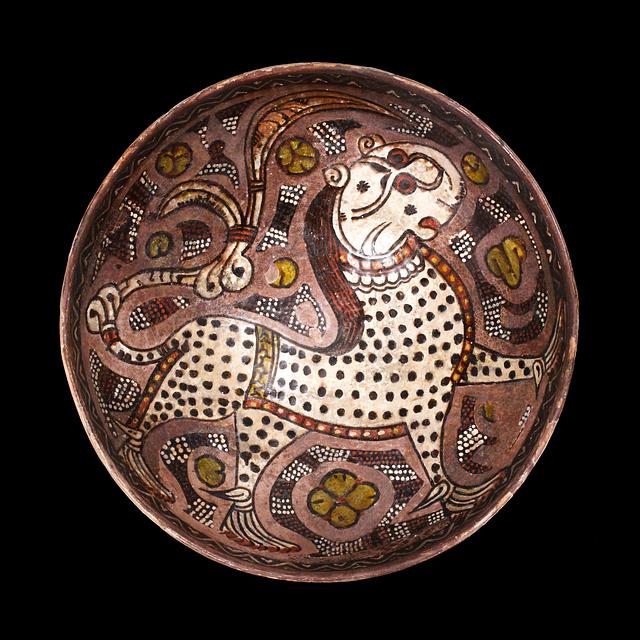
Earthenware bowl, decorated with colored slips over an aubergine-colored ground under a transparent glaze
.-The-David-Collection_photo-Pernille-Klemp.jpg)
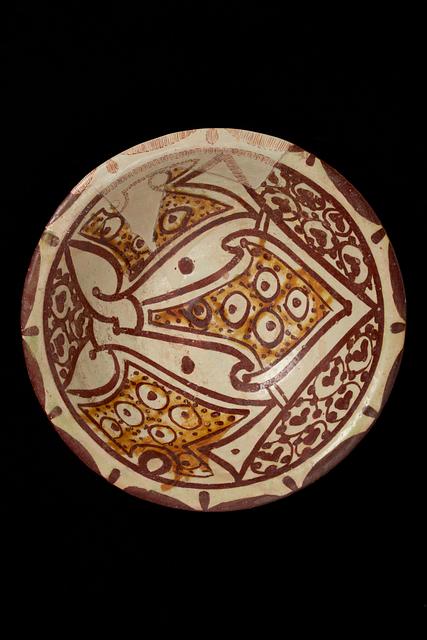
Earthenware bowl, covered with a white slip and painted in a reddish-brown slip under a pale-greenish, transparent glaze, in places with yellow
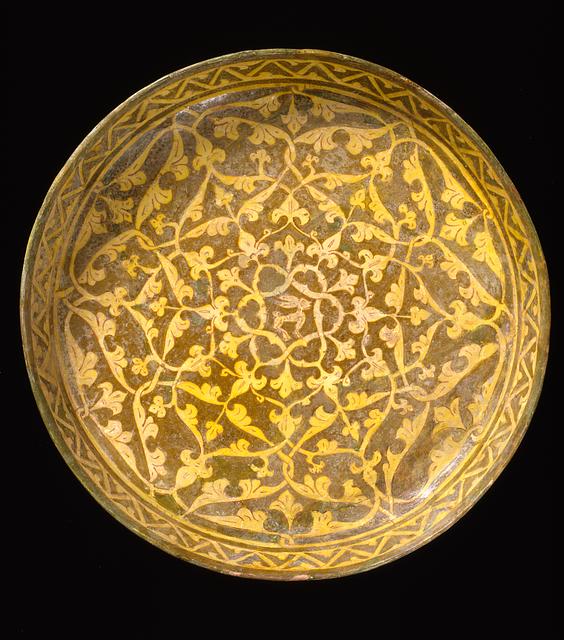
Earthenware dish, covered with a white slip and painted in red and in an olive-green slip under a yellowish glaze
Earthenware bowls covered with a whitish slip and painted with colored slips under a transparent glaze