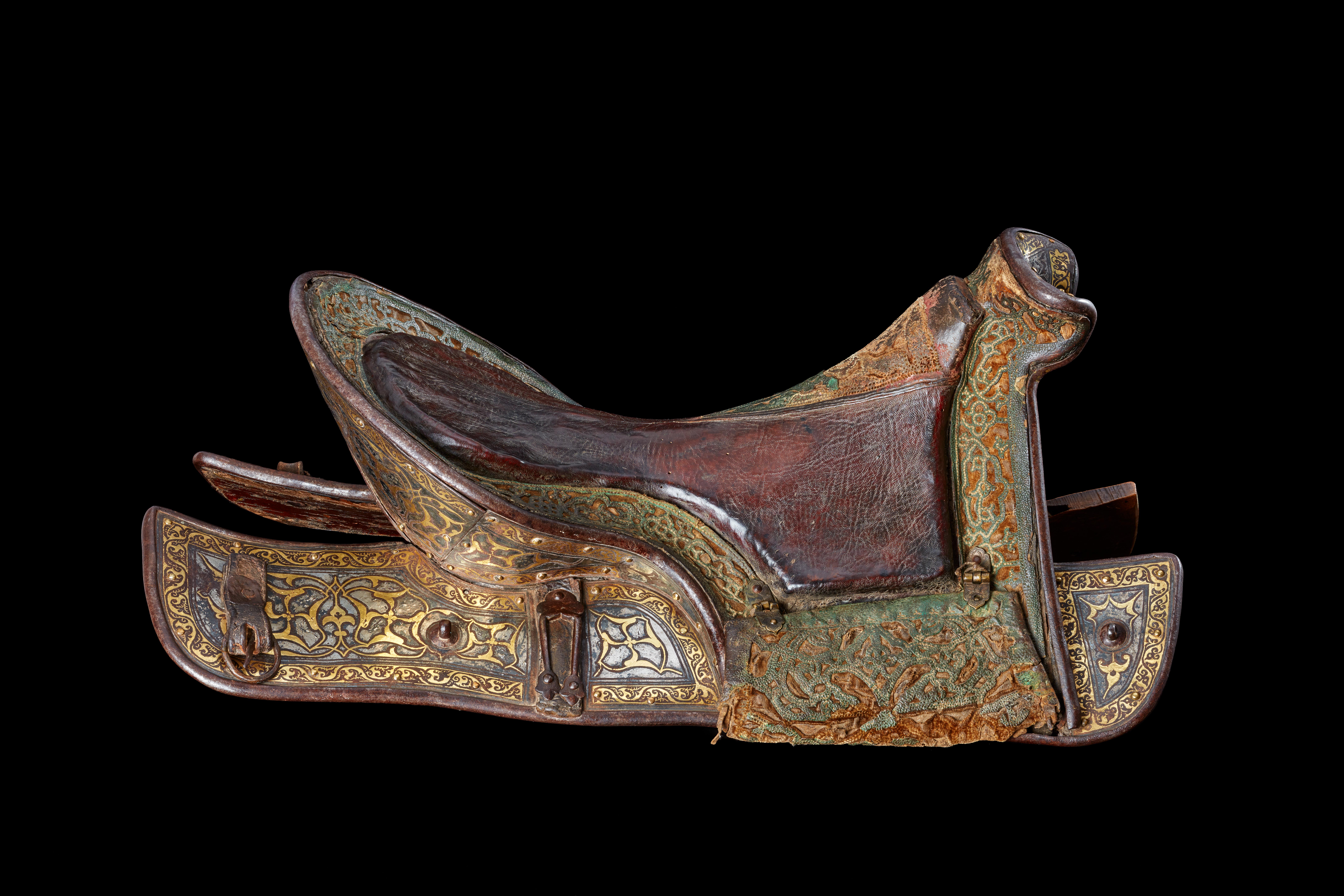
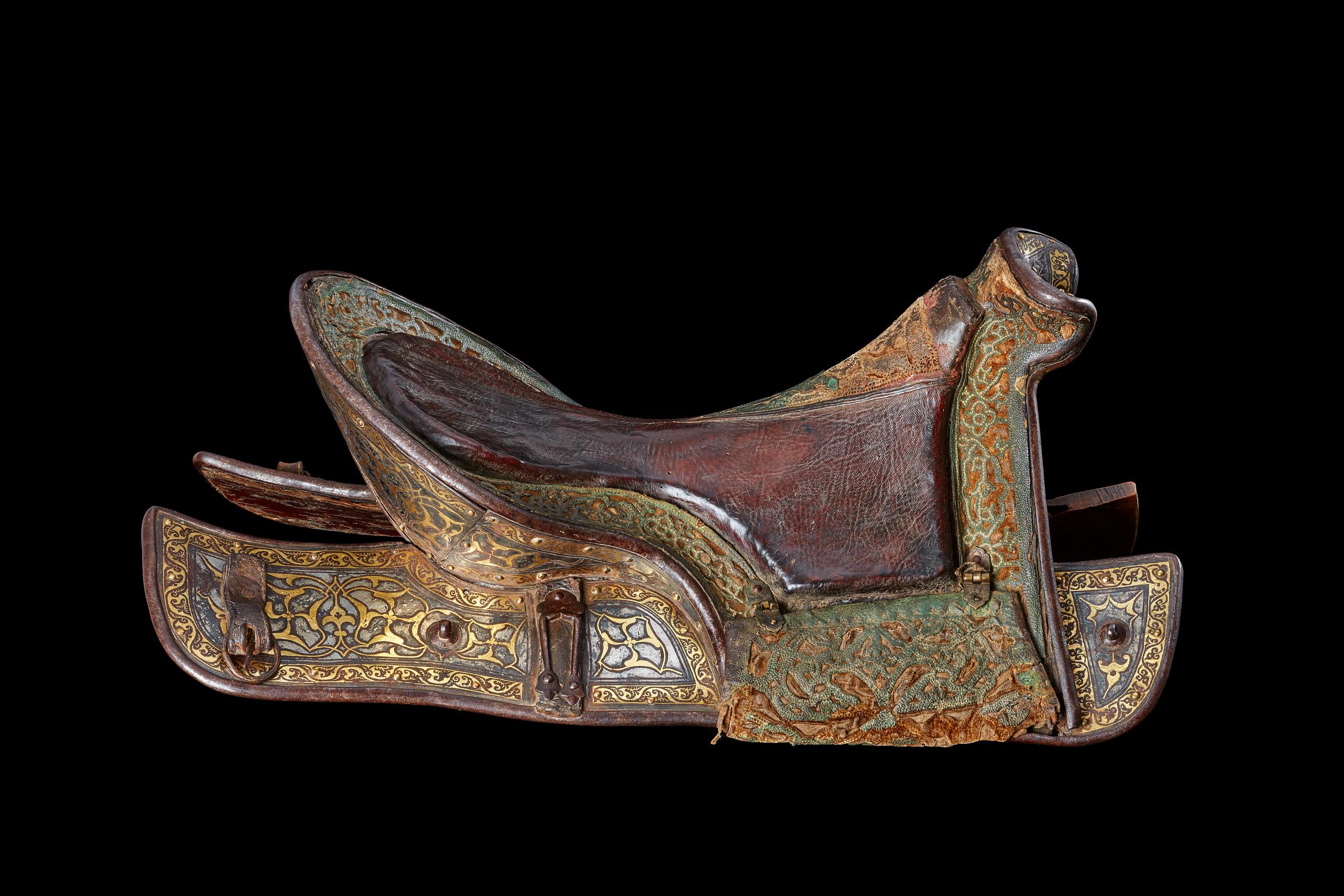
Saddle of wood, leather and textile with iron overlaid in gold and silver
Central Asia; mid-17th century, before 1670
H: 25; W: 34.5; L: 57 cm
Inventory number 15/2019
The Islamic princes’ interest in horses quite naturally extended to saddles, harnesses and other riding equipment, which could be extremely costly and magnificent, as can be seen in miniature paintings (13/2015).
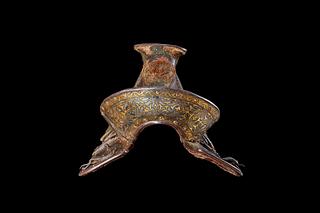
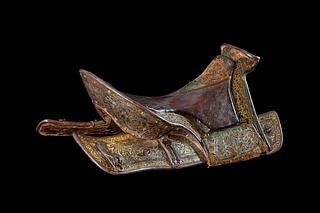
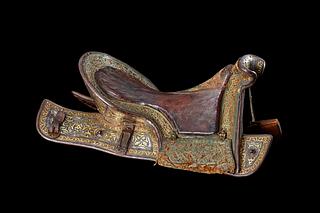
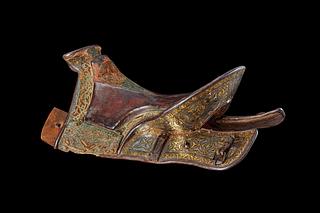
This splendid saddle consists of a wood frame laminated in bark and textile and upholstered in leather and velvet. The horn-like pommel, the sides of the frame and back of the cantle are covered with iron plates carrying gold and silver decorations depicting split-leaf arabesques, curved swastika shapes and inscriptions in Persian.1
An inscription on the front of the pommel announces that the saddle belonged to Yulbars Khan (d. 1670), a descendant of Genghis Khan, who briefly ruled Yarkand, Kashgar and several other caravan towns in western China.
Although we know the identity of the owner, it is unclear exactly where the saddle was made. The shape itself with the steep pommel and fan-like cantle is known from Central Asia and the southern Russian steppes alike. Furthermore, the sewn-on, green leather decorations are reminiscent of later Uzbek leather work, meaning that the saddle may be a gift from one of Yulbars’ princely neighbours to the west. Conversely, the gold and silver decorations may indicate that the saddle was made locally in western China, where similar swastika shapes are featured in architecture from the same period.
This splendid saddle consists of a wood frame laminated in bark and textile and upholstered in leather and velvet. The horn-like pommel, the sides of the frame and back of the cantle are covered with iron plates carrying gold and silver decorations depicting split-leaf arabesques, curved swastika shapes and inscriptions in Persian.1
An inscription on the front of the pommel announces that the saddle belonged to Yulbars Khan (d. 1670), a descendant of Genghis Khan, who briefly ruled Yarkand, Kashgar and several other caravan towns in western China.
Although we know the identity of the owner, it is unclear exactly where the saddle was made. The shape itself with the steep pommel and fan-like cantle is known from Central Asia and the southern Russian steppes alike. Furthermore, the sewn-on, green leather decorations are reminiscent of later Uzbek leather work, meaning that the saddle may be a gift from one of Yulbars’ princely neighbours to the west. Conversely, the gold and silver decorations may indicate that the saddle was made locally in western China, where similar swastika shapes are featured in architecture from the same period.
Published in
Published in
Kjeld von Folsach, Joachim Meyer and Peter Wandel: Fighting, Hunting, Impressing: Arms and Armour from the Islamic World 1500–1850, The David Collection, Copenhagen 2021, cat.no. 71 og Appendix, p. 277;
Footnotes
Footnotes
1.
Kjeld von Folsach, Joachim Meyer, Peter Wandel.: Fighting, Hunting, Impressing: Arms and Armour from the Islamic World 1500–1850, Copenhagen 2021, cat. 71 + Appendix, p. 277.
Metalwork, Weapons and Jewelry