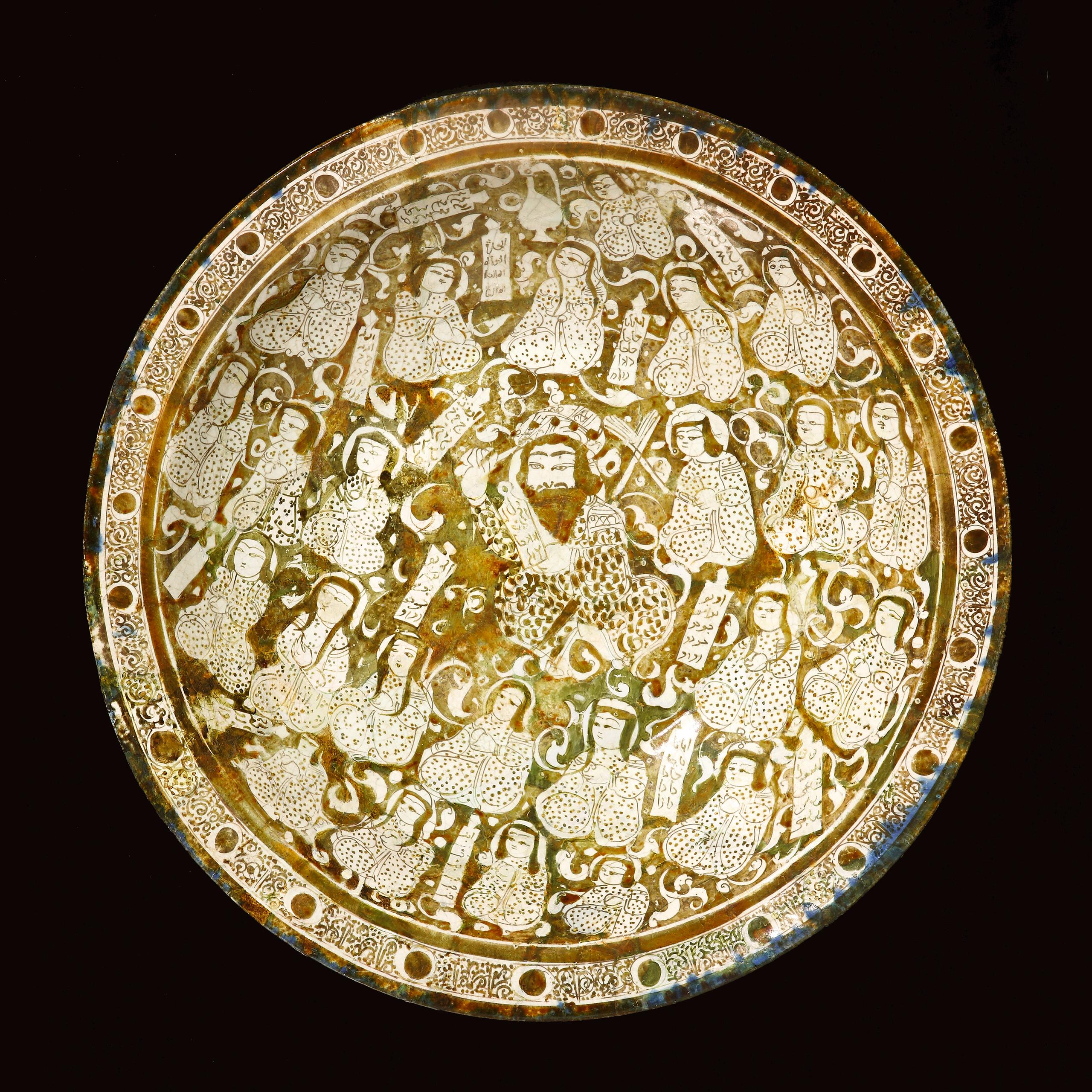
Fritware dish, painted in lustre over an opaque, white glaze
Iran, Kashan; end of 12th century
H: 11; Diam: 47.5 cm
Inventory number 50/1966
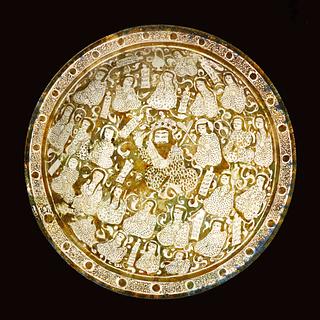
This early Persian dish painted in lustre is unusual with regard to both its size and its dense decoration. It was made in the “monumental style,” in which the unpainted motif emerged on a lustre background after firing. As a result, the motifs were usually fairly simple and striking, something that is actually not the case here.
Twenty-four pupils of both sexes are seated around a bearded teacher, who is wielding a cane. There are also many tablets with various combinations of letters and a bookstand. Everyone is looking the same way except the boy in the top left corner, who is looking at a girl. The scene has been identified as most likely being “the first meeting of Layla and Majnun at school” from Nizami’s famous book Layla and Majnun, written in the 1180s.
Twenty-four pupils of both sexes are seated around a bearded teacher, who is wielding a cane. There are also many tablets with various combinations of letters and a bookstand. Everyone is looking the same way except the boy in the top left corner, who is looking at a girl. The scene has been identified as most likely being “the first meeting of Layla and Majnun at school” from Nizami’s famous book Layla and Majnun, written in the 1180s.
Published in
Published in
Catalogue of the International exhibition of Persian art at the Royal Academy of Arts, 3. ed. Royal Academy of Arts, London 1931, p. 111, cat.no. 172C;
Arthur Upham Pope and Phyllis Ackerman (eds.): A survey of Persian art: from prehistoric times to the present, London 1938-39, vol. 5, pl. 642 and vol. 2, p. 1555, note 2;
Hotel Drout, Paris, June 28, 1950, lot 44;
Bernard Rackham: Islamic pottery and Italian maiolica: illustrated catalogue of a private collection, London 1959, cat.no. 13, p. 9 og pl. 8;
Henry Corbin [et al.]: Les arts de l'Iran, l'ancienne Perse et Bagdad, Bibliothèque Nationale, Paris 1938, p. 200, cat.no. 223 (no photo);
C .L. Davids Samling. Fjerde Del : Jubilæumsskrift 1945-70, København 1970, cat.no. 4, p. 197;
Adalbert Klein [et al.]: Islamische Keramik, Hetjens-Museum, Düsseldorf 1973, cat.no. 113;
André Leth: Davids Samling. Islamisk kunst = The David Collection. Islamic Art, København 1975, pp. 43-44;
The arts of Islam : Hayward gallery, 8 April - 4 July 1976, London 1976, cat.no. 344;
Kjeld von Folsach: Davids Samling gennem 24 år, 1962-1985 = The David Collection: a 24-year period: 1962-1985, København 1985, pp. 52-53;
Oliver Watson: Persian lustre ware, London 1985, figs. 11a-b, p. 49;
Art from the World of Islam. 8th-18th century, Louisiana, Humlebæk 1987, cat.no. 75;
Kjeld von Folsach: Islamic art. The David Collection, Copenhagen 1990, cat.no. 97;
Kjeld von Folsach, Torben Lundbæk and Peder Mortensen (eds.): Sultan, Shah and Great Mughal: the history and culture of the Islamic world, The National Museum, Copenhagen 1996, cat.no. 273;
Christian Heck [et al.]: Moyen age: Chrétienté et islam, Paris 1996, p. 489;
Kjeld von Folsach: Art from the World of Islam in The David Collection, Copenhagen 2001, cat.no. 151;
Baer, Eva: “Muslim teaching institutions and their visual reflections: the kuttâb”, Der Islam, 2001, 78:1, fig. 2 and pp. 75 and 77-78;
Sheila S. Blair and Jonathan M. Bloom (eds.): Cosmophilia. Islamic Art from the David Collection, Copenhagen, McMullen Museum of Art, Boston College, Boston 2006. cat.no. 2;
Sheila p. Blair: “Review of C. Sirat: Writing as handwork, Turnhout 2006” in Bulletin of the School of Oriental and African Studies, 70:2, 2007, p. 417;
Konrad Hirschler: The written word in the medieval Arabic lands: a social and cultural history of reading practices, Edinburgh 2012, pls. 8 and 8a-c;
Eric Vallet, Sandra Aube and Thierry Kouamé (eds.): Lumières de la sagesse: écoles médiévales d’Orient et d’Occident, Institut du monde arabe, Paris 2013, p. xix;
Sheila R. Canby [et al.]: Court and cosmos: the great age of the Seljuqs, Metropolitan Museum of Art, New York, New Haven 2016, cat.no. 173, p. 272;
Sheila Blair and Jonathan Bloom (eds.): By the pen and what they write: writing in Islamic art and architecture, New Haven 2017, fig. 96, p. 124;
Sonja Brentjes: Teaching and learning the sciences in Islamicate societies, 800-1700, Turnhout 2018, p. 48;
Yves Porter: Under the adorned dome: four essays on the arts of Iran and India: Ehsan Yarshater lecture series, Leiden 2023, fig. 2.39, pp. 84, 86;
Arthur Upham Pope and Phyllis Ackerman (eds.): A survey of Persian art: from prehistoric times to the present, London 1938-39, vol. 5, pl. 642 and vol. 2, p. 1555, note 2;
Hotel Drout, Paris, June 28, 1950, lot 44;
Bernard Rackham: Islamic pottery and Italian maiolica: illustrated catalogue of a private collection, London 1959, cat.no. 13, p. 9 og pl. 8;
Henry Corbin [et al.]: Les arts de l'Iran, l'ancienne Perse et Bagdad, Bibliothèque Nationale, Paris 1938, p. 200, cat.no. 223 (no photo);
C .L. Davids Samling. Fjerde Del : Jubilæumsskrift 1945-70, København 1970, cat.no. 4, p. 197;
Adalbert Klein [et al.]: Islamische Keramik, Hetjens-Museum, Düsseldorf 1973, cat.no. 113;
André Leth: Davids Samling. Islamisk kunst = The David Collection. Islamic Art, København 1975, pp. 43-44;
The arts of Islam : Hayward gallery, 8 April - 4 July 1976, London 1976, cat.no. 344;
Kjeld von Folsach: Davids Samling gennem 24 år, 1962-1985 = The David Collection: a 24-year period: 1962-1985, København 1985, pp. 52-53;
Oliver Watson: Persian lustre ware, London 1985, figs. 11a-b, p. 49;
Art from the World of Islam. 8th-18th century, Louisiana, Humlebæk 1987, cat.no. 75;
Kjeld von Folsach: Islamic art. The David Collection, Copenhagen 1990, cat.no. 97;
Kjeld von Folsach, Torben Lundbæk and Peder Mortensen (eds.): Sultan, Shah and Great Mughal: the history and culture of the Islamic world, The National Museum, Copenhagen 1996, cat.no. 273;
Christian Heck [et al.]: Moyen age: Chrétienté et islam, Paris 1996, p. 489;
Kjeld von Folsach: Art from the World of Islam in The David Collection, Copenhagen 2001, cat.no. 151;
Baer, Eva: “Muslim teaching institutions and their visual reflections: the kuttâb”, Der Islam, 2001, 78:1, fig. 2 and pp. 75 and 77-78;
Sheila S. Blair and Jonathan M. Bloom (eds.): Cosmophilia. Islamic Art from the David Collection, Copenhagen, McMullen Museum of Art, Boston College, Boston 2006. cat.no. 2;
Sheila p. Blair: “Review of C. Sirat: Writing as handwork, Turnhout 2006” in Bulletin of the School of Oriental and African Studies, 70:2, 2007, p. 417;
Konrad Hirschler: The written word in the medieval Arabic lands: a social and cultural history of reading practices, Edinburgh 2012, pls. 8 and 8a-c;
Eric Vallet, Sandra Aube and Thierry Kouamé (eds.): Lumières de la sagesse: écoles médiévales d’Orient et d’Occident, Institut du monde arabe, Paris 2013, p. xix;
Sheila R. Canby [et al.]: Court and cosmos: the great age of the Seljuqs, Metropolitan Museum of Art, New York, New Haven 2016, cat.no. 173, p. 272;
Sheila Blair and Jonathan Bloom (eds.): By the pen and what they write: writing in Islamic art and architecture, New Haven 2017, fig. 96, p. 124;
Sonja Brentjes: Teaching and learning the sciences in Islamicate societies, 800-1700, Turnhout 2018, p. 48;
Yves Porter: Under the adorned dome: four essays on the arts of Iran and India: Ehsan Yarshater lecture series, Leiden 2023, fig. 2.39, pp. 84, 86;
The Seljuks and their Successors
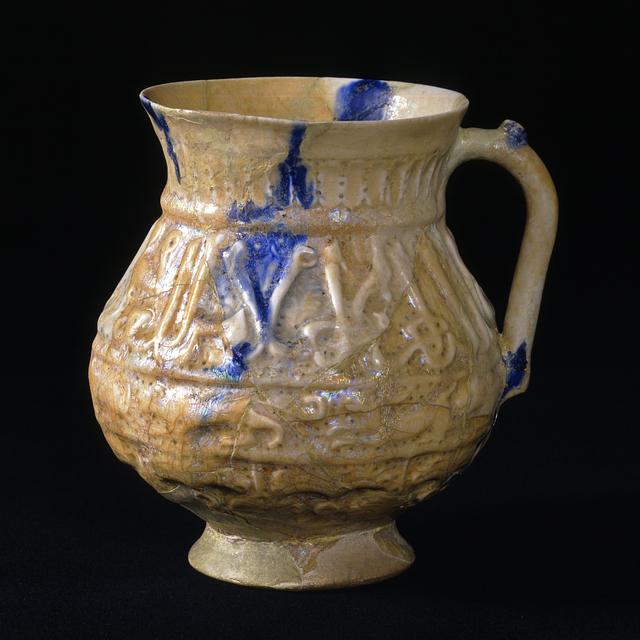
Fritware jug, with molded and openwork decoration and with splashes of blue under a transparent glaze
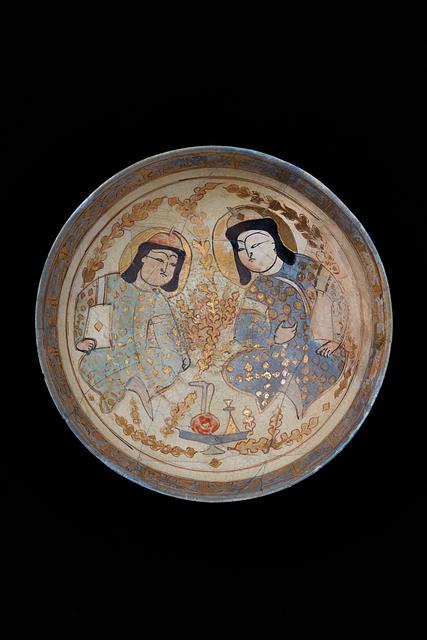
Fritware bowl, with polychrome decoration and gold leaf in and over an opaque, white glaze. Minai type
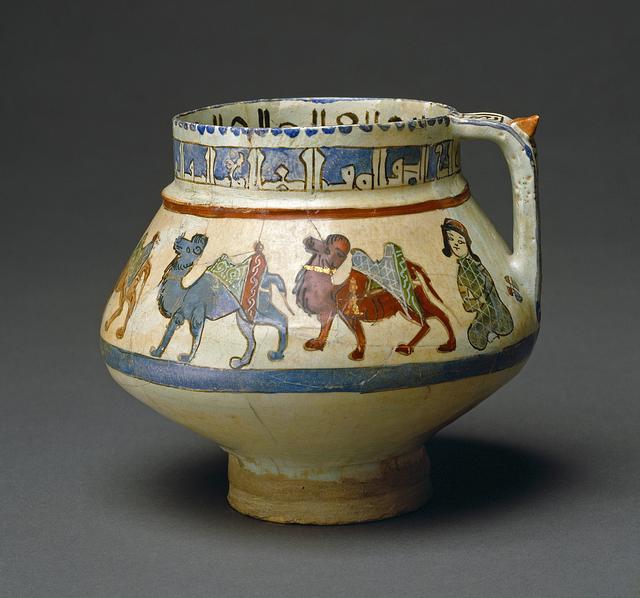
Fritware jug, with polychrome decoration and gold leaf in and over an opaque, white glaze. Minai type
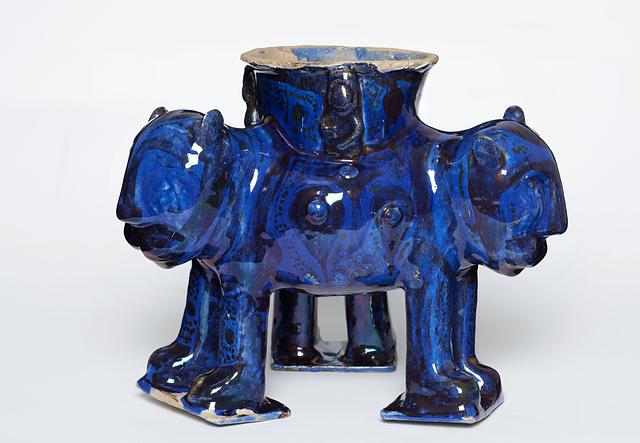
Fritware stand, molded in the form of three lions, covered with a blue glaze and painted in lustre